

I’m not exaggerating when I say that the Master of Wine study program involves A LOT of studying. Stage 1 of the program may only be the tip of the iceberg…but it’s a massive one.
As a result, Stage 1 candidates have a lot of ground to cover in a short period of time. I certainly found myself scrambling! When I was accepted into the Master of Wine study program in September 2025, I was still a relatively fresh graduate from the WSET Diploma program. This gave me a base of knowledge that was still easily retrievable and deployable. But the level of expected acumen and fluency was definitely not the same. Nor was the sheer volume of different topics covered the same. I quickly discovered that I needed to bridge the gap, and bridge it fast.
Like any studious candidate, I consulted a plethora of resources. Technical wine reference books, scientific articles, leading industry websites and publications, podcasts, discussions with winemakers, visits to wineries, examiners reports and past exam papers all formed the foundation of knowledge that I worked to build up. As I said earlier, the learning effort was substantial and I have the stacks of loose leaf paper, notebooks and typed files on my computer to prove it.

Having said that, as I look back on this time in my life, there are a handful of resources that really stand out as materials that I repeatedly went back to over and over again. As I look ahead to Stage 2, I think I will continue to return to this core set of texts to learn what I need to know, or clarify what I have learned elsewhere. This makes these resources invaluable to me.
Listed below are four of the books that I found to be particularly helpful to my MW studies, and why. Perhaps you might find something in this list that you think you should be adding to your library of wine resource texts too.
The Reference Text That Covers It All

If you are going to add only one thing to your library of wine books, make it The Oxford Companion to Wine.
Edited by world renowned MWs, Jancis Robinson and Julia Harding, and containing contributions from countless leading experts, this text covers almost everything you could need or want to know about wine. Seriously.
For me, this text really helped me to connect seemingly unrelated technical topics and concepts. For example, linking fining to clarification, colloids, tannins and tartrates is much more seamless with this resource in hand than without.
I love that this text is written as an encyclopedia, making entries easily searchable and retrievable. There is also plenty of linking of complementary and related concepts throughout, so a reader can cover a lot of ground quickly. The book is available online, making it very convenient for those who want digital access and continuous updates. Personally, I use the hardcover version because I like to thumb through and hold the book and I also think it looks pretty cool sitting on my bookshelf.
Who this book is for:
From the curious enthusiast to the serious wine student, educator or industry professional, this book has something for people at all stages of their journey. Be warned though - it is a serious text and is not written in a light-hearted fashion; nor is it designed in my view to be read cover to cover…there are better books for that style of reading.
The Book That Helped Me Improve My Blind Tasting Calls

As you’ve probably heard me say before, I don’t consider myself to be a naturally gifted blind taster. Blind tasting wine, and making the right call, for the right reason(s), is something that I have to work at.
So, when I find a text that provides a strong framework for blind tasting, I’m all about it. Beyond Flavour is a book that does just that.
Written by Nick Jackson, MW, Beyond Flavour presents an architecture for identifying wines and grapes that is based on the central components of structure - namely acidity and tannins. The author places a significant emphasis on acidity as being especially salient, describing the acidity and texture of different wine grapes and wines from around the world in terms of shapes and tactile sensations. The central premise of this book is that flavours can be misleading, but structure doesn’t lie.
While I don’t take what is shared in this book as absolute truth, I have found the tips and tricks that are shared to be very helpful when trying to wade through what differentiates the sea of options that could be in your wine glass from one another during blind tasting sessions. More than anything, I found the book to be helpful when I made the wrong call - consulting it helped me to think about what I might have missed or misconstrued, and what I need to still practice and master. For example, I always miss Gamay in a blind tasting so I used this book to try to understand what markers are associated with this grape and which other grapes it is most often conflated with in blind tasting - and why. FYI, Gamay can be more herbal than Pinot Noir, which it is often confused with, especially when we are talking about Cru Beaujolais!
Who this book is for:
Like The Oxford Companion to Wine, students may start finding this book useful whenever the ability to describe, assess and/or identify wines under blind tasting conditions becomes important in their journey.
As a Master of Wine candidate, I think this book is hugely helpful because it gives you insight into how a Master of Wine actually succeeded in passing their exams - whether you agree with the approach or not, it still gives you a sense of how you can and should design your own approach.
Equally, I think this book is quite useful for serious wine enthusiasts who wish to become better at understanding the nuances of what they are drinking and/or where various grapes tend to be grown and how they differ in style and expression across growing regions.
The Book That Took Me Behind The Scenes And Into The Vineyard

Viticulture is a complex topic. What occurs in the vineyard can be challenging to grasp if you are not someone who has experience working in a vineyard. Beyond the basic concepts of altitude, slope, water and nutrient availability etc. that all wine students and many wine enthusiasts learn over the years sits a serious amount of detail that makes the proverbial wheel turn.
Given there is a whole exam paper dedicated to viticulture in Stage 2 of the MW study program, and more than likely a mandatory or optional question related to the topic in the Stage 1 MW exam, understanding viticultural concepts is not something that a candidate can take lightly.
Viticulture by Stephen Skelton MW is an excellent reference book for learning the basics of viticulture. For me, it helped me to synthesize the key concepts into succinct frameworks. As an example, soil management is a topic that I spent hours trying to understand - Skelton’s book gave me a baseline to return to in order to keep things from ballooning into abstraction in my mind.
Viticulture covers topics such as vine physiology, the vine growth cycle, vine pests and diseases and water management, and it does so in a relatively accessible manner. The book is theoretical but it also has a practical side to it, as the author has worked as a consultant and an expert in the field for a considerable amount of time and brings his lived experiences into his writing.
Who this book is for:
I would definitely recommend this book as a good starting point for all Master of Wine students, though you will have to go beyond this text to learn enough to feel comfortable that you “get it” in my view (more about that below!).
I would also recommend this book to WSET Level 4 Diploma candidates who are finding that they want supplemental materials to augment the textbook that is provided by the WSET. Someone who is just joining the wine industry and wants to learn the basics fast might find this text to be quite useful too.
The Book That Really Changed The Way I Think About The Grapevine And The Vineyard

While Viticulture is an excellent book that delivers in terms of helping readers understand the various aspects that are critical in viticulture, the nerd in me found true joy in the topic by reading The Science of Grapevines by Markus Keller.
Keller is a researcher and he has truly gone into great detail and depth in this book. He is a clear expert on the topic and everything he says is backed up by scientific research (the reference list/bibliography section of this book is long, let me tell you!).
While incredibly dense and scientifically oriented, I really enjoy reading this book. The serious and complex nature of the vineyard and the vine become abundantly clear as you work through the pages of this text. For example, I always thought the concept of yield was a simple one - reading The Science of Grapevines changed my thinking forever by demonstrating in detail how yield is in fact linked to a plethora of decisions from pruning to canopy management, sunlight exposure and beyond - and how the impact of these decisions is experienced not just in one season, but rather, over long periods of time.
Who this book is for:
This book is for the person who wants to go very deep when it comes to understanding viticulture. There is no middle ground here - you will learn a lot, but you will also have to read and think a lot to attain that knowledge. Stick to Viticulture by Skelton if you are interested in an easier read.
FINAL THOUGHTS
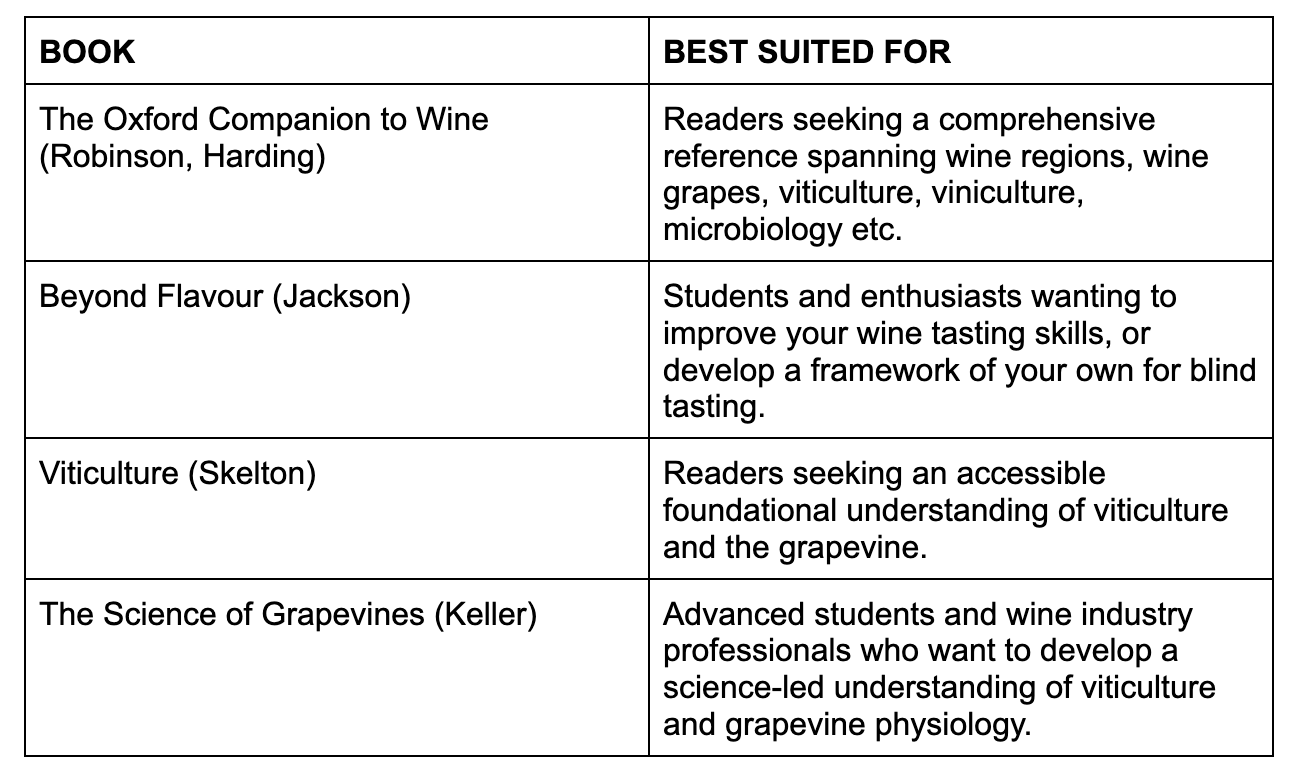
Below is a summary of each of the 4 books that I have recommended in this article, and who I think they are best suited for:
I hope this information helps you find the right book for you and become a more informed wine lover!
If you’d like to read about my some of my specific experiences as a Stage 1 Master of Wine candidate, have a look at these articles: Tackling Stage 1 Course Days, Self Doubt, Blind Tasting and the High Line | A Week in Austria - The Good, The Bad and The Ugly
Is there a wine book or technical reference that has fundamentally changed how you understand wine? Tell me in the comments - I’m always looking for valuable additions to add to my reading list.
Subscribe to follow my journey through the Master of Wine program and discover the books, wines, places and humbling lessons that are changing both my understanding of wine and me as a person.
Until next time,
A.